

Why Does Your Industrial Agitator Consume Too Much Power?
If you run a chemical plant, pharmaceutical unit, food processing factory, or wastewater treatment facility, electricity bills are likely one of your biggest operational expenses. Inside these facilities, a large percentage of energy is continuously consumed by liquid mixing equipment. When plant managers look closely at their power meters, one common question keeps popping up: Why does our industrial agitator consume so much power?
An industrial agitator that draws excess power does not just increase your monthly electricity bills. It also puts unnecessary stress on your motor, causes frequent equipment overheating, creates unnecessary wear and tear, and leads to costly sudden downtime.
If your process mixing unit is consuming more power than it should, you do not always need to buy a bigger motor. In fact, excessive energy consumption is often a clear signal that your current mixing setup is inefficient, poorly matched, or outdated.
In this comprehensive guide, we will break down the real causes behind high power consumption in mixing systems, show you how to identify hidden operational losses, and explain how partnering with a top agitator manufacturer like Dosimix Technologies can drastically lower your energy costs while improving product quality.
The Hidden Cost of High Agitator Power Consumption
Many factory owners focus only on the initial purchase price when buying mixing machinery. However, the purchase price of an industrial agitator typically represents less than 15% of its total lifetime cost. The remaining 85% goes directly toward energy consumption and routine maintenance.
When an agitator draws extra electrical power day after day:
- Electricity Costs Soar: A motor running inefficiently for 24 hours a day can cost thousands of extra rupees every single month.
- Motor and Gearbox Life Decreases: High power draw generates excess mechanical heat. This heat breaks down gear lubricants, damages bearings, and reduces motor winding life.
- Batch Quality Suffers: Excess power often translates into uncontrolled turbulent splashing or improper fluid circulation rather than effective fluid movement.
- Frequent Unplanned Downtime: Overloaded motors trip circuit breakers and break down unexpectedly, stopping your production line completely.
Understanding why your mixing system consumes too much power is the first step toward building a leaner, more profitable production line.
5 Common Reasons Your Industrial Agitator Consumes Too Much Power
Power consumption in fluid mixing is directly connected to how fluid moves inside your tank. Here are the five primary reasons your current system is wasting energy:
1. Using the Wrong Impeller Design
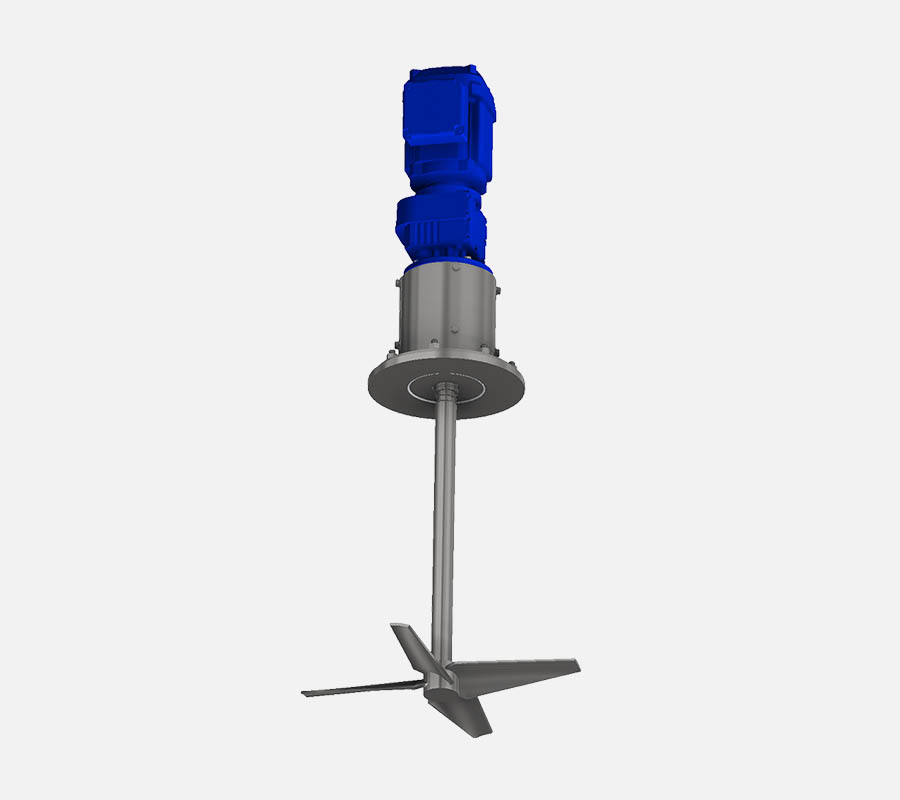
The impeller is the heart of any industrial agitator. Different mixing applications require different types of fluid flow.
- Axial Flow: Pushes liquid up and down (best for top-to-bottom blending and solid suspension).
- Radial Flow: Pushes liquid outward toward the tank walls (best for gas dispersion and intense shearing).
If your supplier gave you a standard radial flow impeller for a simple liquid blending process, the motor will work twice as hard to move the liquid. You end up burning heavy electricity without getting a properly mixed product. Choosing the right blade geometry is critical, and a reputed industrial agitator manufacturer will always select the impeller shape based on your specific liquid behavior.
2. Over-Sizing or Outdated Motor Motors
A common mistake in many industrial factories across India is installing an oversized motor “just to be safe.” While an oversized motor ensures the agitator never stops, it often operates at low power factor efficiency when underloaded, wasting energy continuously.
Conversely, using an outdated motor technology with lower energy ratings draws significantly more current to produce the same mechanical rotational force.
3. Operating at Fixed High Speeds Without Variable Drives
Liquid thickness (viscosity) often changes during a mixing batch. For instance, in chemical synthesis or food processing, ingredients start thin like water and become thick like paste during reaction or cooling.
If your agitator runs at a constant high RPM throughout the entire batch cycle:
- It consumes maximum power even when high speed is no longer required.
- It creates excess heat during the low-viscosity phase.
Without a Variable Frequency Drive (VFD) to adjust rotation speeds dynamically, your motor constantly pulls full electrical load even when lower speeds would achieve perfect mixing.
4. Incorrect Tank Geometry and Lack of Baffles
Many buyers focus entirely on the agitator machine and forget about the tank itself. When liquid spins inside a smooth round tank without proper wall baffles, the fluid begins to rotate like a continuous whirlpool (vortexing).
When a vortex forms:
- The liquid simply spins together as a solid mass instead of mixing.
- The impeller loses effective contact resistance, making the motor work harder to maintain fluid velocity.
- Energy is wasted turning the liquid around in circles without actually mixing the ingredients.
Adding correctly positioned wall baffles breaks the whirlpool motion and turns wasted rotational power into useful mixing action.
5. Mechanical Friction and Wear
Old bearings, misaligned drive shafts, improper gear lubrication, and worn-out mechanical seals create internal mechanical resistance. When internal components rub against each other, the electric motor must draw extra amperes simply to overcome internal mechanical friction before it can even begin to move the liquid inside the tank.
How Inefficient Agitators Impact Industrial Buyer ROI
For an industrial buyer or procurement head, equipment performance directly impacts profit margins. Let us look at a simple comparison between a standard low-cost agitator and an energy-efficient engineered mixing system:
Performance Factor | Standard / Non-Optimized Agitator | Custom Energy-Efficient Agitator |
Impeller Design | Generic standard blades | Hydraulically optimized custom profile |
Power Consumption | High (Wastes up to 30-40% energy) | Low (Optimized power draw per batch) |
Motor Life | Reduced due to continuous heat & load | Extended with balanced torque load |
Mixing Uniformity | Inconsistent with dead zones | Complete uniform blend in faster time |
Overall Operating Cost | High recurring monthly expenses | Fast payback on initial investment |
Investing in a well-designed mixing system from a leading agitator manufacturer lowers your monthly operational expenses (OPEX) and delivers higher long-term profitability.
Actionable Steps to Reduce Your Agitator’s Power Consumption
If your factory is currently experiencing high power consumption on its mixing lines, here is a practical checklist you can follow right away:
- Audit Your Fluid Viscosity: Check if your liquid thickness changes during production. Ensure your motor is matched to the maximum operating viscosity, not an arbitrary over-calculated number.
- Install Variable Speed Controls (VFDs): Allow operators to slow down the agitator speed during filling, heating, or holding phases when intense agitation is not required.
- Inspect Mechanical Alignment: Regularly check shaft straightness, bearing lubrication, and seal pressure to eliminate mechanical friction.
- Evaluate Impeller Efficiency: Upgrade older high-drag blades to modern high-efficiency axial flow impellers designed to move larger volumes of fluid with less rotational resistance.
- Partner with an Expert Manufacturer: Consult a trusted industrial agitator manufacturer who conducts real process analysis before quoting machine specifications.
Why Dosimix Technologies is the Best Industrial Agitator Manufacturer in India
When it comes to reducing energy costs and getting reliable mixing performance, buying an off-the-shelf, one-size-fits-all mixer is never the right answer. Every liquid process is unique, and your equipment should be engineered specifically for your batch requirements.
This is where Dosimix Technologies excels as one of the best industrial agitator manufacturers in India.
What Makes Dosimix Technologies the Preferred Choice for Industrial Buyers?
Dosimix Technologies does not just sell machinery; we deliver complete, energy-efficient fluid mixing solutions tailored to your operational goals.
- Custom Hydraulic Engineering: Dosimix Technologies designs custom impellers that maximize fluid displacement while minimizing motor energy draw.
- Energy-Efficient Motor Options: Every industrial agitator manufactured by Dosimix Technologies uses high-efficiency energy-rated motors designed to keep your electricity bills low.
- Wide Industry Expertise: Whether you need robust mixing for chemical synthesis, gentle blending for food processing, sanitary agitation for pharmaceuticals, or continuous duty mixing for water treatment plants, Dosimix Technologies delivers purpose-built solutions.
- Robust Built Quality: Built using high-grade stainless steel and special alloys, agitators from Dosimix Technologies are crafted for long service life, zero vibration, and minimal maintenance costs.
- End-to-End Customer Support: From initial process evaluation and custom design to installation guidance and long-term service support, Dosimix Technologies stands as your long-term industrial mixing partner.
By upgrading your production line with custom equipment from Dosimix Technologies, you reduce monthly electrical load, shorten batch mixing times, and achieve superior product consistency across every batch.
Upgrade to Energy-Efficient Mixing Today
Stop letting an inefficient industrial agitator drain your plant’s monthly profits. Excess energy consumption is an avoidable operational loss that can easily be corrected with the right blade design, motor sizing, and tank setup.
If you are looking to lower your factory operating costs, improve product quality, or replace old, energy-hungry mixing equipment, reach out to the experts at Dosimix Technologies. As a premier agitator manufacturer and trusted industrial agitator manufacturer in India, Dosimix Technologies provides high-performance, energy-saving agitator solutions engineered specifically for your business growth.
Contact Dosimix Technologies today to request a custom consultation and discover how much energy your plant can save on your next mixing project!
FAQs
An industrial agitator may consume excessive power because of an incorrect impeller design, oversized or outdated motor, unnecessarily high operating speed, poor tank geometry, inadequate baffles, or mechanical friction. High fluid viscosity and shaft or gearbox problems can also increase the required power.
Impeller design directly affects the amount of power required to move a liquid. An impeller that is poorly matched to the fluid and mixing objective can create unnecessary resistance and turbulence. Selecting the correct axial-flow, radial-flow, or specialized impeller can improve fluid circulation while reducing power consumption.
Yes. An oversized motor can operate inefficiently when the actual mixing load is significantly lower than its rated capacity. Proper motor sizing based on fluid viscosity, tank conditions, impeller design, operating speed, and process requirements can help achieve more efficient energy use.
Yes, a Variable Frequency Drive (VFD) can reduce energy consumption when the mixing process does not require constant high speed. A VFD allows operators to adjust agitator RPM according to different process stages, such as filling, blending, heating, reaction, or holding.
Tank baffles prevent excessive swirling and vortex formation in round tanks. Without proper baffles, the liquid may rotate around the tank instead of circulating effectively from top to bottom. Correctly designed baffles can improve mixing efficiency and help convert motor power into useful fluid movement.
Yes. Higher-viscosity fluids generally require greater torque to achieve the required fluid movement. If an agitator is designed for a low-viscosity liquid but the process becomes significantly thicker, the motor may experience higher load and power demand. Agitator selection should therefore consider the full viscosity range of the process.
Yes. Worn bearings, shaft misalignment, inadequate gearbox lubrication, damaged seals, and other mechanical problems can increase friction. The motor then requires additional torque to overcome this resistance, which can increase current draw and reduce overall equipment efficiency.
Start by checking impeller selection, motor sizing, operating RPM, fluid viscosity, tank geometry, baffle arrangement, shaft alignment, bearings, gearbox lubrication, and mechanical seals. Installing a VFD and upgrading to a more efficient impeller can also reduce unnecessary energy consumption.
Choose an industrial agitator based on fluid viscosity, density, tank size and geometry, required mixing objective, operating speed, batch or continuous operation, and chemical compatibility. An experienced agitator manufacturer can evaluate these process conditions and engineer the impeller, shaft, motor, and drive system accordingly.
Yes. Dosimix Technologies provides customized industrial agitator solutions designed around specific process requirements. Its approach can include application-based impeller selection, appropriate motor sizing, variable-speed operation, and robust mechanical construction for industries such as chemical processing, pharmaceuticals, food processing, and wastewater treatment.