

How to Select an Industrial Agitator Based on Viscosity, Tank Size & Process Type
If you are an industrial plant manager, procurement head, or engineer in India, you know that mixing isn’t just about “stirring.” Whether you are handling thick polymers or treating millions of litres of wastewater, the efficiency of your production line depends on one critical piece of equipment: the Industrial Agitator.
Choosing the wrong agitator doesn’t just result in poor mixing—it leads to wasted energy, motor burnout, and expensive downtime. In this guide, we will break down exactly how to select the perfect Industrial Agitator for your specific needs, focusing on viscosity, tank dimensions, and industry standards.
When it comes to high-performance mixing solutions, Dosimix Technologies stands out as the Best Industrial Agitator Manufacturer in India, providing custom-engineered solutions for every industrial challenge.
1. Understanding Viscosity: The Heart of Agitator Selection
Viscosity (the thickness of your liquid) is the single most important factor in choosing an agitator based on viscosity. A motor that works for water will fail instantly if used for heavy syrup or paint.
Low Viscosity (Water-like)
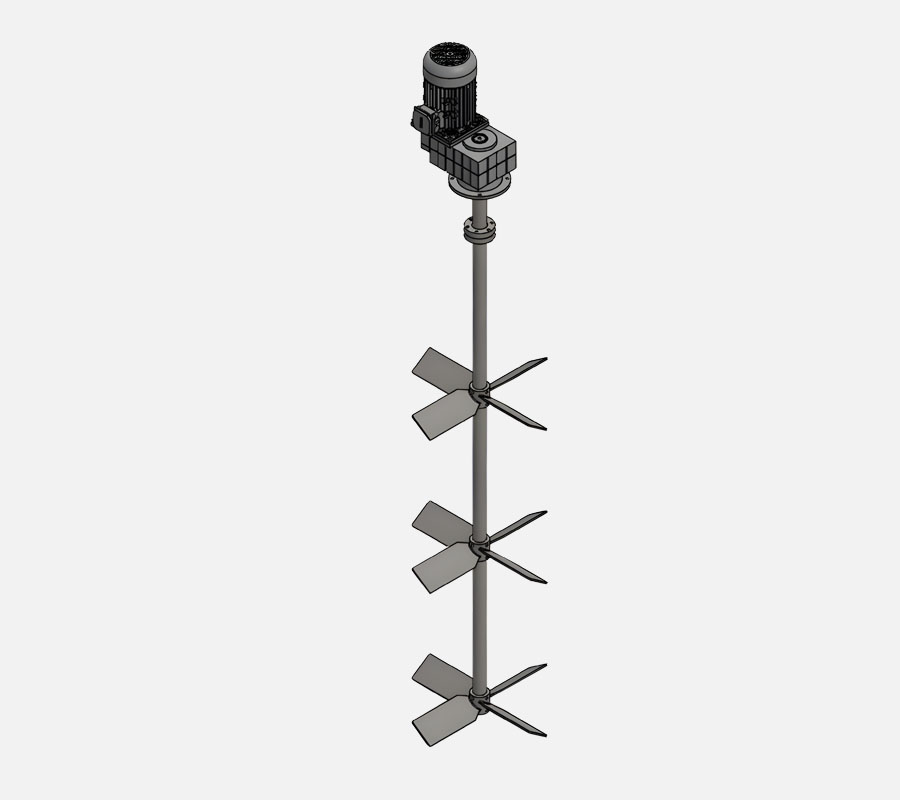
For liquids like water or light oils, you need high-speed movement to create turbulence. An industrial agitator for water treatment typically uses a propeller or turbine design to ensure chemicals are dispersed quickly.
Medium Viscosity (Oil, Paint, Light Food Items)
In sectors like the agitator for paint mixing or light food processing, the fluid resists movement more. Here, we look at “Pitched Blade” turbines that provide both axial and radial flow to ensure no “dead zones” remain in the tank.
High Viscosity (Creams, Pastes, Resins)
For the agitator for pharma industry (making thick ointments) or the agitator for food processing (handling dough or thick sauces), high torque is required. Instead of high speed, you need high “sweep.” Dosimix Technologies specializes in Anchor and Helical Ribbon agitators designed to “scrape” the walls and move heavy masses efficiently.
2. Matching Your Agitator to Tank Size
The geometry of your tank determines how the fluid circulates. A tall, narrow tank requires a different approach than a short, wide one.
- Small to Medium Tanks: Top-entry vertical agitators are standard. They are mounted centrally and provide powerful mixing for most chemical and pharmaceutical processes.
- Large Storage Tanks: When you are dealing with massive volumes (like 100,000+ liters in oil or large-scale water plants), a top-entry shaft becomes too heavy and expensive. This is where a side entry agitator becomes the hero. By mounting the mixer on the side wall, you achieve massive fluid movement with much lower power consumption.
- Mixing Tank Specifics: For an agitator for mixing tank setups involving solids, the tank bottom shape (conical vs. flat) will influence where we place the impellers to prevent solids from settling.
3. Selecting by Process Type & Industry
Every industry has a unique “mixing goal.” Selecting based on the application ensures you get the right results.
Agitator for Chemical Tank
Chemical reactions often require precise temperature control and homogenization. Whether you are blending acids or processing polymers, an agitator for chemical tank applications must be made from corrosion-resistant materials like SS316 or specialised coatings. Dosimix Technologies offers chemically inert designs that withstand the harshest environments.
Industrial Agitator for Wastewater Treatment
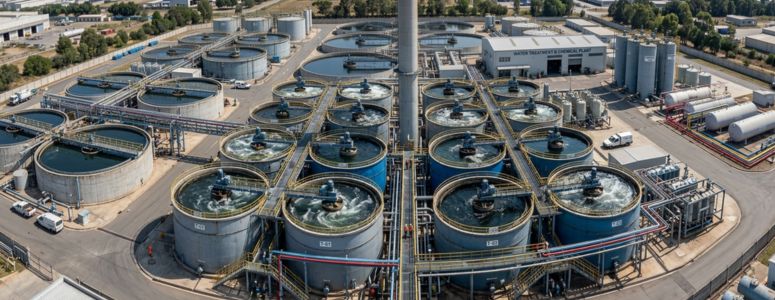
In ETP (Effluent Treatment Plants) and STP (Sewage Treatment Plants), the goal is often flocculation or aeration. An industrial agitator for wastewater treatment needs to be robust enough to handle grit and debris while being energy-efficient for 24/7 operation.
Agitator for Pharma & Food Industry
Hygiene is the priority here. These agitators feature “Sanitary Designs” with mirror-finish surfaces and no gaps where bacteria can grow. Whether it’s an agitator for the pharma industry or agitator for food processing, we ensure compliance with international food-grade standards.
4. Industrial Mixer vs Agitator: What’s the Difference?
Buyers often get confused between these two terms. In the Indian market, they are often used interchangeably, but there is a subtle difference:
- Industrial Mixer: Usually refers to a device that combines two or more different materials into one (like powder into liquid).
- Industrial Agitator: Usually refers to a device that keeps a pre-mixed substance in a specific state (like preventing settling in a slurry or keeping a chemical reaction active).
Knowing the industrial mixer vs agitator distinction helps you communicate better with manufacturers to get the exact torque and RPM required for your batch.
Why Choose Dosimix Technologies?
If you are looking for a reliable Industrial Agitator Manufacturer in India, look no further. Dosimix Technologies has earned a reputation for engineering excellence across the country.
Why Indian Buyers Trust Us:
- Custom Engineering: We don’t believe in “one size fits all.” We analyse your liquid’s specific gravity, viscosity, and tank dimensions before suggesting a design.
- PAN India Presence: From the industrial hubs of Gujarat and Maharashtra to the pharma clusters in Hyderabad and the textile mills of Tamil Nadu, we supply and support clients across the whole of India.
- Durability: Our agitators are built for the heavy-duty demands of Indian industries, ensuring long life with minimal maintenance.
- Energy Efficiency: With rising power costs, our high-efficiency impellers ensure you get maximum mixing with minimum electricity consumption.
Our Range Includes:
- High-Speed Propeller Agitators
- Heavy-Duty Anchor Agitators
- Side Entry Agitator for large storage
- Specialised agitator for wastewater treatment
- Customised agitator for paint mixing and resins
Get the Right Mixing Solution Today
Selecting an Industrial Agitator is a capital investment that affects your product quality for years. Don’t leave it to chance. Whether you need an agitator for a chemical tank or a high-torque agitator based on viscosity, the experts at Dosimix Technologies are here to help.
Stop struggling with poor mixing quality and high maintenance costs. Switch to the most trusted name in the industry.
Ready to upgrade your plant? Contact Dosimix Technologies—the Best Industrial Agitator Manufacturer in India—for a consultation and a high-performance mixing solution tailored to your business.
FAQs
The most important factor is the viscosity of the liquid. It determines whether you need a high-speed agitator for low-viscosity fluids or a high-torque agitator for thick materials like resins, creams, or sludge.
- Low viscosity (water, solvents): Use propeller or turbine agitators for fast mixing
- Medium viscosity (oil, paint): Use pitched blade turbines for balanced flow
- High viscosity (paste, polymers): Use anchor or helical ribbon agitators for strong torque and wall scraping
An agitator for chemical tank applications should be:
- Made from corrosion-resistant materials (SS316)
- Designed for uniform mixing and reaction control
- Compatible with aggressive chemicals
An industrial agitator for water treatment typically uses:
- High-speed propellers or turbines
- Designed for aeration, flocculation, and chemical dosing
- Built for continuous 24/7 operation
Tank size determines:
- Mounting type (top entry or side entry)
- Impeller size and number
- Power requirement (HP/kW)
Large tanks often require side entry agitators to reduce shaft load and improve efficiency.
- Industrial Mixer: Combines different materials (e.g., powder + liquid)
- Industrial Agitator: Maintains uniformity or prevents settling in an already mixed solution
Understanding this helps in selecting the correct equipment for your process.
For thick fluids like:
- Adhesives
- Food pastes
- Pharma creams
You need anchor agitators or helical ribbon agitators that provide high torque and low-speed mixing.
For an agitator for mixing tank handling solids:
- Use bottom-mounted or multi-impeller systems
- Consider tank shape (conical or flat bottom)
- Ensure proper placement to avoid sedimentation
For pharma and food processing, the agitator must:
- Have sanitary design (no contamination risk)
- Use food-grade materials
- Ensure easy cleaning (CIP/SIP compatibility)
A custom industrial agitator ensures:
- Perfect match with viscosity, tank size, and process
- Higher efficiency and lower power consumption
- Reduced downtime and maintenance costs
Standard agitators may not meet specific industrial requirements.