


Why Manual Chemical Dosing Fails & How Injection Skids Fix It
If your plant relies on manual chemical dosing, you are likely facing hidden costs and safety risks. For modern process industries, the transition from manual handling to a high-performance chemical injection skid is no longer a luxury—it is a requirement for operational stability and regulatory compliance.
In sectors such as water treatment, oil and gas, and pharmaceutical manufacturing, precision is the difference between a profitable batch and a catastrophic system failure. Yet, many facilities continue to use manual or semi-manual dosing methods that are inherently flawed.
This guide explores why manual dosing is the “silent killer” of industrial efficiency and how custom-engineered injection skid systems from experts like Dosimix Technologies provide the precision, safety, and ROI that global industries demand.
The Hidden Costs of Manual Chemical Dosing Problems
When we speak of “manual dosing,” we refer to the process where operators manually measure, mix, and pour chemicals into a process stream or open tank. While this might seem cost-effective in terms of initial CAPEX, the long-term OEPX and risk profile are staggering.
1. The Precision Gap: Inconsistent Concentration
Manual dosing is subject to human error. Even the most diligent operator cannot match the millilitre-perfect precision of an automated chemical dosing system.
- Under-dosing: Leads to incomplete reactions, microbial growth in water treatment, or insufficient corrosion inhibition in pipelines.
- Over-dosing: Results in massive chemical wastage and can potentially damage downstream equipment or contaminate the final product.
2. Operational Safety and Liability
Handling hazardous chemicals—such as sulfuric acid, sodium hypochlorite, or volatile hydrocarbons—manually exposes workers to fumes, splashes, and chronic health risks. In the modern regulatory landscape, minimising “Man-Chemical Interface” is a primary goal for EHS (Environment, Health, and Safety) departments. A failure in manual handling isn’t just a spill; it’s a potential multi-million dollar liability.
3. Maintenance and Equipment Longevity
Manual dosing often involves “slug feeding” (dumping a large amount of chemical at once). This creates localized high concentrations that can lead to accelerated corrosion of pipes and tanks. A chemical dosing skid ensures a steady, metered flow that maintains the chemical equilibrium of the entire system.
What is a Chemical Injection Skid?
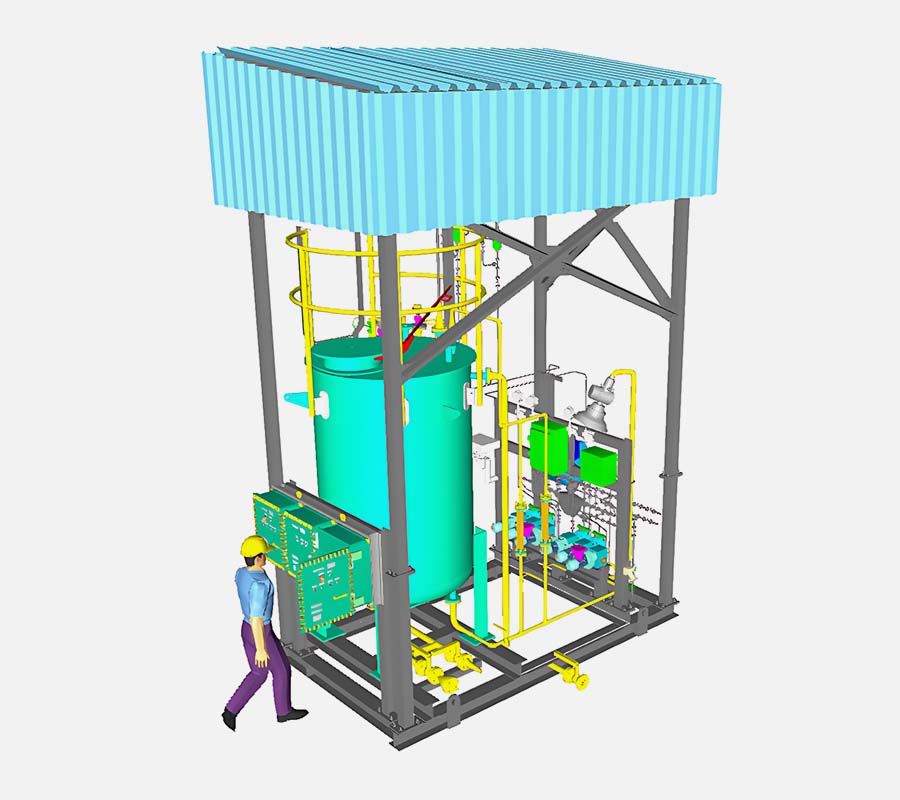
A chemical injection skid is a self-contained, frame-mounted system designed to safely and accurately inject specific chemicals into a process line. These systems are “plug-and-play,” meaning they are engineered, assembled, and tested in a controlled factory environment before being shipped to the site.
At Dosimix Technologies, our skids typically integrate:
- Metering Pumps: The heart of the system (diaphragm or plunger type).
- Piping and Valves: Constructed from materials compatible with the chemical (SS316, PVC, PP, PTFE).
- Instrumentation: Flow meters, pressure transmitters, and level sensors.
- Control Panel: PLC-based systems that allow for chemical dosing automation.
- Calibration Columns: To ensure the pump is delivering the exact required volume.
How an Injection Skid System Fixes Manual Failures
Moving from manual intervention to an injection skid system transforms the process from a “best guess” to a “data-driven” operation.
Total Chemical Dosing Automation
By integrating sensors and PLC controls, an automated system can adjust dosing rates in real-time based on process variables like flow rate, pH levels, or pressure change. This closed-loop control eliminates the “Why manual chemical dosing fails” question entirely by removing the human variable.
Modular and Scalable Design
Unlike permanent, poured-in-place manual stations, a chemical dosing skid is modular. If your plant capacity increases, you can simply add another module or upgrade the pump size within the existing skid framework.
Enhanced Safety Features
Dosimix Technologies designs skids with secondary containment, leak detection, and emergency shut-off valves. By keeping chemicals contained within a closed-loop skid, you protect your workforce and your facility’s environmental footprint.
Industry-Specific Applications for Dosing Skids
The requirements for a chemical injection skid manufacturer vary significantly by industry. A “one-size-fits-all” approach usually leads to premature system failure.
1. Injection Skid for Water Treatment
In municipal and industrial water treatment, dosing coagulants, flocculants, and disinfectants is critical. Accuracy ensures that water meets potability standards without exceeding residual chlorine limits.
2. Injection Skid for Oil and Gas
In the upstream and midstream sectors, chemicals like corrosion inhibitors, scale inhibitors, and demulsifiers are injected into high-pressure lines. These industrial chemical dosing solutions must be rugged enough to withstand offshore or desert environments.
3. Dosing Skid for Chemical Industries
For complex chemical synthesis, the rate of addition of catalysts or reagents can dictate the exothermic profile of a reaction. Precision here is a matter of process safety (PSM).
Key Benefits of Chemical Injection Skids (The Business Impact)
Decision-makers—from procurement heads to plant managers—need to see the bottom-line impact. Here is the ROI breakdown of investing in a chemical dosing system:
- Reduction in Chemical Consumption: Most plants see a 15-25% reduction in chemical waste after switching to automated skids.
- Lower Labour Costs: Operators are freed from manual mixing and monitoring, allowing them to focus on higher-value maintenance and optimisation tasks.
- Regulatory Compliance: Automated systems provide digital logs of every drop injected, making environmental audits seamless.
- Reduced Downtime: Skids from a reputable chemical injection skid manufacturer are built for 24/7 operation with minimal intervention.
Choosing the Right Chemical Injection Skid Manufacturer
The market is flooded with “integrators,” but there is a massive difference between a simple pump-on-a-base and a high-performance chemical injection skid. When evaluating a partner like Dosimix Technologies, look for these technical benchmarks:
- Material Compatibility: Does the manufacturer understand the NACE or ASTM standards required for your specific chemical?
- Custom Engineering: Avoid “off-the-shelf” solutions. Your skid should be designed for your specific flow, pressure, and temperature.
- Testing Protocols: Ensure every skid undergoes Hydro-testing, Loop testing, and Functional Acceptance Testing (FAT) before dispatch.
- Global Reach: For companies operating in India and the Middle East, having a partner who understands regional heat, humidity, and logistics is vital.
Dosimix Technologies: Your Partner in Process Excellence
At Dosimix Technologies, we don’t just build hardware; we engineer reliability. As a leading chemical injection skid manufacturer, we serve clients across India, the Middle East, and globally, providing tailored solutions for the most demanding process environments.
Our team of engineers specialises in identifying the specific bottlenecks in your current dosing setup. Whether you need a compact chemical dosing skid for a small effluent plant or a multi-pump, high-pressure injection skid system for an oil refinery, we provide the technical depth and manufacturing precision required to keep your plant running at peak efficiency.
The risks of manual chemical dosing—waste, safety hazards, and process instability—are too high in today’s competitive landscape. By switching to an automated chemical dosing system, you secure your plant’s future.
Are you ready to optimize your dosing process? Contact Dosimix Technologies today for a technical consultation. Let’s design a chemical injection skid that solves your manual dosing problems and drives your industrial performance forward.
Contact Us : +91 76007 37948, sales@dosimixtechnologies.com
FAQs
Manual dosing introduces human error, leading to inconsistent chemical concentrations. This results in process inefficiency, potential equipment corrosion, and significant safety hazards for operators handling hazardous substances.
A high-quality skid includes metering pumps, suction and discharge piping, valves (pressure relief, back pressure), instrumentation (flow/pressure sensors), a PLC-based control panel, and a structural frame with secondary containment.
By providing precise, automated dosing, skids reduce chemical wastage by 15-25%, lower labor costs, prevent expensive equipment damage due to over-dosing, and ensure regulatory compliance, avoiding heavy fines.
Yes. Manufacturers like Dosimix Technologies engineer custom skids specifically for high-pressure environments, such as those found in offshore oil and gas or boiler feed water systems.
Material selection depends on the chemical’s corrosive properties. Common options include Stainless Steel (SS316/316L), PVC, Polypropylene (PP), Carbon Steel, and PTFE-lined components for highly aggressive acids.
A dosing pump is a single component used to move fluid. A dosing skid is a complete, integrated system that includes the pump, piping, controls, and safety features, ready for immediate “plug-and-play” installation.
Modern automated skids are designed for high reliability. Standard maintenance typically involves periodic calibration of pumps, checking seals/gaskets, and verifying sensor accuracy, usually during planned plant shutdowns.
While not “mandatory” for every application, PLC automation is highly recommended for processes requiring real-time adjustments, data logging for compliance, and integration with a central SCADA or DCS system.
Skids minimize direct contact with chemicals. Features like leak detection sensors, secondary containment trays, and emergency shut-off valves provide multiple layers of protection that manual methods lack.
Generally, skids are designed for specific chemicals to avoid cross-contamination and material incompatibility. However, multi-pump skids with dedicated lines for different chemicals can be engineered on a single frame.
Reliable manufacturers adhere to international standards such as ASME (piping and welding), API 675 (metering pumps), NACE (corrosion), and CE/UL for electrical control panels.
Yes. Dosimix Technologies offers custom engineering, manufacturing, and technical support for clients in India, the Middle East (UAE, Saudi Arabia, Oman), and various global industrial hubs.