


Dosing Pump Selection Guide: Flow Rate, Pressure, Chemical Compatibility & More
Choosing the right dosing pump is more than just a procurement task; it is a critical engineering decision that affects the safety, efficiency, and longevity of your entire chemical injection system. Whether you are treating municipal water, managing boiler chemistry, or injecting catalysts in a petrochemical process, a mismatch in pump specifications can lead to costly downtime, chemical wastage, or equipment failure.
At Dosimix Technologies, we understand that engineers and plant managers need precision. This guide serves as a technical roadmap to help you navigate the complexities of pump sizing, material selection, and system integration, featuring our specialized DMM Series and Accudo Series.
What is a Dosing Pump and Why Does Selection Matter?
A dosing pump (also known as a metering pump) is a positive displacement device designed to inject a precise volume of liquid into a process fluid at specific intervals. Unlike standard centrifugal pumps, dosing pumps are engineered for accuracy—typically within ±1% of the rated flow.
Inaccurate selection usually results in two scenarios:
- Under-sizing: The pump fails to overcome system pressure or meet the required chemical concentration.
- Over-sizing: Excessive pulsation, “slug” dosing rather than a smooth flow, and premature wear on the diaphragm or seals.
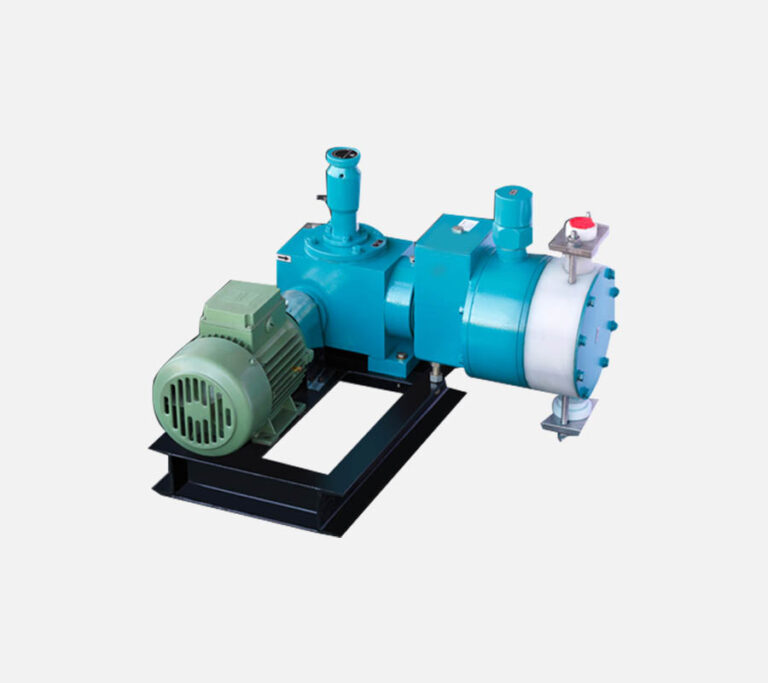
Defining Your Flow Rate Requirements
The first step in how to choose a dosing pump is calculating the required capacity. You must determine the maximum amount of chemical needed per hour (LPH or GPH).
Dosing Pump Capacity Calculation
To find your required flow rate, use the following logic:
- Process Flow Rate: How much water or fluid is moving through the main line?
- Dosage Rate: What is the target concentration (e.g., 5 ppm or 10 mg/L)?
- Chemical Concentration: Is the chemical pure or diluted?
Pro-Tip: Always size your pump so that your normal operating point falls between 30% and 85% of the pump’s maximum capacity. Running a pump at 10% capacity often leads to poor stroke consistency, while running at 100% reduces the lifespan of the mechanical components.
Understanding Dosing Pump Pressure Calculations
Pressure is where most selection errors occur. A chemical dosing pump must be able to generate a discharge pressure higher than the “Back Pressure” of the system it is injecting into.
Key Pressure Factors:
- Static Discharge Head: The vertical distance the chemical must be lifted.
- System Pressure: The internal pressure of the pipe or vessel where the injection occurs.
- Friction Loss: Pressure lost as the fluid moves through valves, bends, and long tubing runs.
The Golden Rule: Ensure the pump’s maximum pressure rating is at least 10-15% higher than the total calculated back pressure. If you are injecting into a 10-bar line, a 12-bar rated pump is the minimum safe requirement.
Advanced Dosing Pump Technologies at Dosimix
Not all industrial dosing pumps operate the same way. The drive mechanism changes how the chemical is delivered. At Dosimix Technologies, we categorize our solutions based on the actuation method to meet specific industrial rigors.
Mechanically Actuated Diaphragm Pumps (DMM Series)
The DMM Series features a diaphragm directly coupled to the drive mechanism. These are the most common choice for general water treatment and industrial processes.
- Best for: Low to medium pressure applications.
- Advantage: Cost-effective, zero-leakage design, and easy maintenance.
- Dosimix Highlight: Our DMM Series is engineered for continuous duty with high-precision stroke adjustment.
Hydraulically Actuated Diaphragm Pumps (Accudo Series)
The Accudo Series utilizes a hydraulic fluid to flex the diaphragm. This balances the pressure on both sides of the diaphragm, significantly extending its life.
- Best for: High-pressure applications and harsh industrial environments.
- Advantage: Extremely durable; includes built-in relief valves to protect the pump head from over-pressure.
- Dosimix Highlight: The Accudo Series is the “workhorse” for critical chemical injection where reliability is the top priority.
Plunger Pumps
These pumps use a high-precision solid piston (plunger) to displace fluid.
- Best for: Extremely high pressures (up to 500 bar) and non-hazardous fluids.
- Advantage: Highest mechanical efficiency and capability to handle very high discharge heads.
- Note: Since the plunger is in direct contact with the fluid, proper seal selection is vital.
Chemical Compatibility: Choosing the Right Materials
The “wet end” of the pump—including the head, diaphragm, valves, and O-rings—must be chemically inert to the fluid being handled. Dosing pump material compatibility is non-negotiable for safety.
Chemical Component | Recommended Material (Liquid End) | Recommended Seal/O-Ring |
Sodium Hypochlorite | PVDF / PVC | Viton / EPDM |
Sulfuric Acid (High Conc.) | PVDF / SS316 | PTFE (Teflon) |
Caustic Soda | PP / SS316 | EPDM |
Polymer/Flocculant | PP / PVC | Viton |
Solvents | SS316 | PTFE |
Dosimix Technologies Recommendation: Always consult a Material Safety Data Sheet (MSDS) before finalizing materials. Factors like temperature and concentration can drastically change how a chemical reacts with plastics or elastomers.
Control and Automation Features
Modern chemical dosing systems require more than just a “plug-and-play” motor. Depending on your process, you may need:
- Manual Control: Adjusting the stroke length or frequency via a manual dial.
- Analogue Control (4-20mA): The pump speeds up or slows down based on a signal from a flow meter or pH controller.
- Pulse/Digital Input: The pump strokes once for every “X” litres of water measured by a pulse-output meter.
- Proportional Dosing: Automatically maintaining a constant concentration regardless of flow fluctuations in the main line.
Critical Accessories for Your Dosing System
A dosing pump is only as good as the loop it sits in. To ensure a professional installation, engineers should include:
- Foot Valve & Strainer: Prevents debris from entering the pump head.
- Pressure Relief Valve (PRV): Essential for safety; it protects the pump and piping if a downstream valve is accidentally closed.
- Back Pressure Valve: Ensures the pump sees a consistent pressure, preventing “siphoning” when the suction tank is higher than the injection point.
- Pulsation Dampener: Smooths out the “jerky” flow of positive displacement pumps, protecting fragile instrumentation downstream.
- Calibration Cylinder: A graduated tube used to verify the actual flow rate of the pump during commissioning.
Common Dosing Pump Applications
Dosimix Technologies solutions are utilised across a variety of sectors:
- Water & Wastewater Treatment: Disinfection (chlorine), pH adjustment (acids/alkalis), and coagulation (alum).
- Food & Beverage: Dosing of flavours, preservatives, and Clean-in-Place (CIP) chemicals.
- Agriculture: Fertigation and water acidification in greenhouses.
- Power Plants: Scale inhibition in boilers and cooling towers using the Accudo Series.
- Mining: Injecting flocculants for tailings management using the DMM Series.
Avoiding Common Sizing Mistakes
- Ignoring Viscosity: Thick fluids (like polymers) require larger suction lines and slower stroke speeds. Standard pumps may fail to prime with viscous liquids.
- Vapor Lock: Chemicals like Hydrogen Peroxide or Chlorine gas can “off-gas” in the pump head, causing the pump to lose prime. Using a pump with an auto-bleeding valve is essential here.
- Suction Lift Issues: Dosing pumps are great at pushing (discharge) but often poor at pulling (suction). Always keep the pump as close to the chemical tank as possible.
Ensuring Precision with Dosimix Technologies
Selecting the right dosing pump is a balance of hydraulic calculation, chemical science, and mechanical engineering. By accurately defining your dosing pump flow rate, verifying dosing pump pressure calculations, and ensuring total chemical compatibility, you protect your process from inconsistency and failure.
Whether your application demands the versatile DMM Series (Mechanically Actuated) or the robust Accudo Series (Hydraulically Actuated), Dosimix Technologies provides precision-engineered fluid handling solutions tailored to your needs.
Need expert help with your dosing pump selection? [Contact the Dosimix Technologies engineering team today] for a custom sizing consultation and ensure your system operates at peak efficiency.
Contact US : +91 76007 37948 , sales@dosimixtechnologies.com
FAQs
A dosing pump is a precision positive displacement pump used to inject a controlled amount of chemical into a process line. It works by displacing a fixed volume per stroke, ensuring accurate and repeatable dosing, typically within ±1% accuracy.
To calculate dosing pump flow rate, you need:
- Process flow rate (LPH or m³/hr)
- Desired dosage (ppm or mg/L)
- Chemical concentration
Multiply process flow by dosage and adjust for concentration to get the required pump capacity.
- Undersized pump: Cannot overcome system pressure or meet chemical demand
- Oversized pump: Causes pulsation, inaccurate dosing, and faster wear
For optimal performance, operate the pump between 30%–85% of its maximum capacity.
You must calculate total back pressure, including:
- System pressure
- Static head
- Friction losses
Select a pump with 10–15% higher pressure rating than the calculated requirement to ensure safe operation.
- Mechanically actuated diaphragm pumps: Ideal for low to medium pressure and general applications
- Hydraulically actuated diaphragm pumps: Best for high-pressure and critical processes
- Plunger pumps: Suitable for very high-pressure, non-hazardous fluids
Selection depends on pressure, chemical type, and process criticality.
Chemical compatibility ensures that pump materials (like PVDF, SS316, PTFE) do not react with the fluid. Incorrect material selection can lead to corrosion, leakage, or system failure, making it a critical safety factor.
Common wetted materials include:
- PVDF / PVC: For oxidizing chemicals like sodium hypochlorite
- SS316: For solvents and high-strength chemicals
- PP: For alkalis and polymers
- PTFE / EPDM / Viton: For seals and O-rings
Material selection should always be verified with the chemical’s MSDS.
Modern dosing pumps support:
- Manual stroke adjustment
- 4–20 mA analog control
- Pulse-based dosing
- Proportional dosing systems
These features enable automation and precise chemical injection based on real-time process conditions.
Essential accessories include:
- Foot valve with strainer
- Pressure relief valve (PRV)
- Back pressure valve
- Pulsation dampener
- Calibration cylinder
These components improve safety, accuracy, and system stability.
Key mistakes include:
- Ignoring fluid viscosity
- Not accounting for vapor lock (off-gassing chemicals)
- Poor suction conditions or long suction lines
- Incorrect pressure calculations
Avoiding these ensures reliable and efficient dosing system performance.